Introduction
If you have ever consulted an Ayurvedic doctor, you may have heard words like rasa, rakta, or ojas during your assessment. These terms are not random — they refer to the 7 dhatus in Ayurveda, the foundational body tissues that Ayurvedic medicine has studied for over 5,000 years.
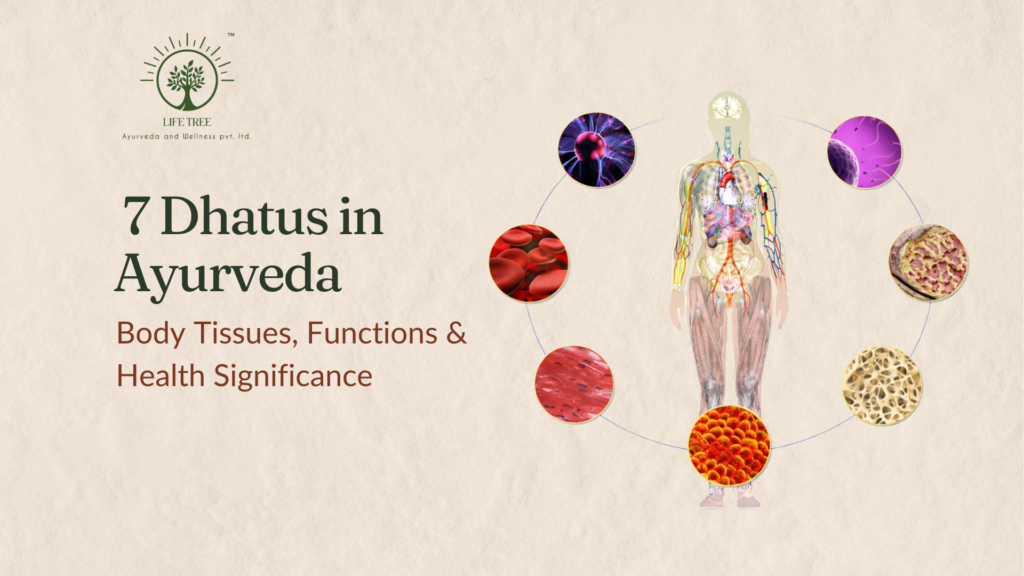
According to classical Ayurvedic texts like the Charaka Samhita and Sushruta Samhita, the 7 dhatus (also called Sapta Dhatu) are the seven structural and functional tissues that form, nourish, and sustain every organ and system in the body. When these tissues are balanced and well-nourished, health flourishes. When they become depleted or imbalanced, disease begins.
Understanding your dhatus is one of the most important steps toward understanding why you feel the way you do — and what your Ayurvedic practitioner is working to restore.
What Are Dhatus in Ayurveda?
The word dhatu comes from Sanskrit, meaning “that which supports the body.” In Ayurveda, each dhatu is sequentially formed from the previous one in a seven-stage process of tissue refinement. Food you eat is first converted into Ahara Rasa (nutritional essence), which then nourishes each dhatu in order — from the most liquid (plasma) to the most refined (reproductive tissue).
This process of transformation is governed by Agni (digestive fire) at each stage. According to Ayurveda, the quality of every downstream tissue depends on the strength of digestion in the tissues before it. This is why Ayurvedic treatment rarely targets a single organ in isolation — it works on the entire tissue chain.
The 7 Dhatus in Ayurveda: A Complete Guide
1. Rasa Dhatu — Plasma / Lymph
Rasa Dhatu is the first and most foundational tissue in Ayurveda, formed directly from digested food. It corresponds to blood plasma, lymph, and the chyle formed in the digestive system.
Primary function: Nourishment — Rasa carries nutrients to every other tissue in the body, much like the lymphatic and circulatory systems work in modern physiology.
Signs of imbalance: Fatigue, dehydration, dry skin, poor immunity, low breast milk production in nursing mothers, and feelings of emptiness or anxiety are classic signs of depleted Rasa Dhatu.
Ayurvedic nourishment: Sweet, unctuous, and easily digestible foods such as warm milk, rice, and root vegetables are traditionally prescribed to rebuild Rasa.
2. Rakta Dhatu — Blood
Rakta Dhatu corresponds to the red blood cells and the blood as a whole, with a particular emphasis on the liver and spleen as its governing organs.
Primary function: Oxygenation — Rakta brings life force (Prana) and oxygen to all tissues, and governs complexion, vitality, and enthusiasm.
Signs of imbalance: Anaemia, pale or yellowish skin, chronic fatigue, inflammatory skin conditions, excessive heat in the body, liver disorders, and frequent infections are associated with Rakta imbalance.
Ayurvedic nourishment: Iron-rich foods, leafy greens, pomegranate, beets, and blood-purifying herbs like Manjistha and Neem are used to support Rakta Dhatu.
3. Mamsa Dhatu — Muscle Tissue
Mamsa Dhatu refers to the muscle tissues of the body — both skeletal and smooth muscle — along with the tendons and ligaments that support them.
Primary function: Strength and movement — Mamsa Dhatu gives the body its physical power, stability, and the ability to move. It also provides protection to the bones and vital organs beneath it.
Signs of imbalance: Muscle weakness, wasting, stiffness, heaviness, or excessive weight gain can all reflect Mamsa imbalance. Conditions like myalgia, muscular atrophy, or even excessive muscle tightness fall under this category.
Ayurvedic nourishment: Protein-rich foods, sesame, urad dal, well-cooked meat broths (for non-vegetarians), and herbs like Ashwagandha are used to strengthen Mamsa.
4. Meda Dhatu — Adipose / Fat Tissue
Meda Dhatu encompasses the body’s fat tissue and fatty reserves, including subcutaneous fat, visceral fat, and the fat stored within bones and organs.
Primary function: Lubrication — Meda Dhatu lubricates joints, cushions organs, maintains body temperature, and stores energy. It also nourishes the eyes and skin.
Signs of imbalance: Both excess (obesity, sluggishness, high cholesterol, joint heaviness) and deficiency (extreme leanness, dry joints, cracking bones, fatigue) indicate Meda imbalance.
Ayurvedic nourishment: In excess: light, dry, and bitter foods with fat-metabolising herbs like Triphala and Guggulu. In deficiency: healthy fats like ghee, sesame oil, and almonds.
5. Asthi Dhatu — Bone Tissue
Asthi Dhatu refers to the skeletal system — all bones, cartilage, teeth, nails, and the structural framework that holds the body upright.
Primary function: Structure — Asthi provides the body’s physical foundation, protects vital organs, and serves as the site of blood cell production (marrow).
Signs of imbalance: Osteoporosis, cracking joints, brittle nails and teeth, hair loss, bone pain, and excessive bone growths (bone spurs) are all associated with Asthi imbalance.
Ayurvedic nourishment: Calcium-rich sesame seeds, dairy (especially warm milk with turmeric), leafy vegetables, and herbs like Shatavari and Bala are traditionally used to fortify Asthi.
6. Majja Dhatu — Bone Marrow and Nervous Tissue
Majja Dhatu corresponds to the bone marrow and the nervous system — including the brain, spinal cord, and the fatty substance that fills the interior of bones.
Primary function: Communication — Majja governs the nervous system’s ability to send and receive signals. It also supports the immune system, mental clarity, and emotional balance.
Signs of imbalance: Neurological disorders, multiple sclerosis-like conditions, deep bone pain, poor memory, dizziness, tingling in limbs, anxiety, and difficulty concentrating can all reflect compromised Majja Dhatu.
Ayurvedic nourishment: Brain-supportive herbs like Brahmi, Shankhpushpi, and Ashwagandha, combined with warm ghee, are classical Majja-building protocols.
7. Shukra / Artava Dhatu — Reproductive Tissue
Shukra (male) and Artava (female) Dhatu represent the reproductive tissues — sperm, ova, and the full reproductive system — and are considered the most refined, precious tissue in the body.
Primary function: Reproduction and vitality — Beyond fertility, Shukra/Artava Dhatu is responsible for Ojas, the essential vital essence that governs immunity, radiance, longevity, and spiritual wellbeing.
Signs of imbalance: Infertility, low libido, hormonal disorders, premature ageing, low immunity, loss of lustre, and persistent fatigue are all signs that the seventh dhatu is depleted.
Ayurvedic nourishment: Foods and herbs that build Ojas — Shatavari, Ashwagandha, warm milk, dates, almonds, and saffron — are used to restore reproductive vitality.
How Dhatu Imbalance Leads to Disease
In Ayurveda, most diseases can be traced back to a disruption in the sequential formation of the dhatus. If Rasa Dhatu is weak, every downstream tissue suffers. If Agni (digestive fire) at any stage is impaired, toxins (Ama) accumulate in that tissue and begin to block its function.
According to the Charaka Samhita, disease manifests first as imbalance in the dhatus before it becomes clinically evident. This is precisely why Ayurvedic diagnosis (through pulse examination, tongue observation, and detailed history) often identifies tissue-level disturbances long before modern tests can detect them.
Factors that disrupt dhatus include:
- Poor diet and irregular eating patterns
- Chronic stress and insufficient sleep
- Suppressed natural urges (holding back urination, defecation, emotions)
- Excessive physical or mental exertion
- Seasonal changes and environmental exposure
How Ayurvedic Treatment Supports Your Dhatus
Restoring the dhatus is at the heart of Ayurvedic treatment. At Lifetree Ayurveda, our practitioners evaluate your dhatu health as part of every comprehensive consultation.
Treatment protocols commonly include:
- Dietary therapy (Ahara Chikitsa): Foods are prescribed based on which dhatu is depleted or aggravated.
- Herbal formulations: Classical Ayurvedic preparations like Chyawanprash, Ashwagandhadi Lehyam, and Drakshadi Kashaya are formulated to address specific dhatu deficiencies.
- Panchakarma: Deep detoxification therapies like Virechana, Basti, and Nasya remove Ama from dhatus and reset the tissue transformation cycle.
- Rasayana therapy: A specialised class of Ayurvedic rejuvenation medicines designed to deeply nourish all seven dhatus and rebuild Ojas.
- Lifestyle adjustments (Vihara): Sleep hygiene, daily routine (Dinacharya), and yoga are calibrated to reduce the lifestyle factors that deplete dhatus.
Frequently Asked Questions About the 7 Dhatus
What are the 7 dhatus in Ayurveda?
The 7 dhatus (Sapta Dhatu) are Rasa (plasma), Rakta (blood), Mamsa (muscle), Meda (fat), Asthi (bone), Majja (marrow/nerves), and Shukra/Artava (reproductive tissue). Each dhatu is sequentially formed from the previous one through a process governed by digestive fire (Agni) and together they form the structural and functional foundation of the human body.
What is the most important dhatu in Ayurveda?
All dhatus are interdependent, but Rasa Dhatu is considered the foundation because it nourishes all subsequent tissues. Shukra/Artava Dhatu is considered the most refined, as it produces Ojas — the body’s ultimate vitality and immune essence.
What causes dhatu imbalance?
Dhatu imbalance is caused by poor diet, weak digestion (low Agni), chronic stress, irregular sleep, overexertion, accumulated toxins (Ama), and lifestyle habits inconsistent with one’s Prakriti (body constitution). Seasonal and environmental factors also play a role.
How are dhatus related to doshas?
Doshas (Vata, Pitta, Kapha) and dhatus are interrelated. Each dosha governs specific dhatus — for example, Kapha governs Rasa and Mamsa, Pitta governs Rakta and Meda, and Vata governs Asthi and Majja. A dosha imbalance will eventually manifest as dhatu dysfunction if left unaddressed.
Can Ayurvedic treatment repair damaged dhatus?
Yes. Through Rasayana (rejuvenation) therapies, targeted herbal protocols, dietary adjustments, and Panchakarma detoxification, Ayurvedic treatment is specifically designed to restore, nourish, and repair depleted or imbalanced dhatus. Results depend on the extent of imbalance, the patient’s constitution, and adherence to the prescribed protocol.
What is Ojas and how does it relate to dhatus?
Ojas is the refined, vital essence produced at the end of healthy dhatu formation — specifically from Shukra/Artava Dhatu. It governs immunity, longevity, mental clarity, and spiritual wellbeing. When all 7 dhatus are properly nourished, Ojas is abundant. When dhatus are depleted or Agni is weak, Ojas diminishes, and the body becomes susceptible to illness and fatigue.
Conclusion: Your Dhatus Are the Key to Lasting Health
The 7 dhatus in Ayurveda represent a sophisticated, time-tested model of human physiology — one that goes far beyond symptomatic treatment and addresses the root of health at the level of body tissue itself.
Understanding your dhatus helps you understand why you may feel constantly fatigued despite eating well, why some patients heal quickly while others struggle, and why Ayurvedic treatment often produces benefits that extend well beyond the original complaint.
If you are exploring Ayurvedic treatment for a chronic condition, digestive issue, hormonal imbalance, or general loss of vitality, a dhatu assessment with a qualified Ayurvedic practitioner is one of the most insightful starting points available to you.
Ready to understand what your body truly needs? Book a consultation at Lifetree Ayurveda and let our practitioners assess your dhatu health and design a personalised treatment plan.
About the Author
Dr. Sujith R S is an experienced Ayurveda Consultant and Centre Head at Life Tree Ayurveda and Wellness Pvt. Ltd., Bengaluru, with over 6 years of clinical experience in holistic Ayurvedic healthcare. Rooted in classical Ayurvedic principles, he focuses on treating the root cause of health issues through personalized and patient-centric therapies.
He specializes in managing joint disorders such as knee pain, low back pain, and chronic musculoskeletal conditions, and has strong expertise in authentic Panchakarma treatments. Passionate about spreading the true essence of Ayurveda, Dr. Sujith is committed to providing ethical, natural, and sustainable healing solutions that improve long-term wellness and quality of life.